
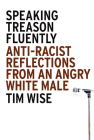
I really wanted to like Tim Wise's new book,
Speaking Treason Fluently. And at first I did. The articles at the beginning about Obama's campaign were very interesting and relevant to the election at hand (I started reading it sometime at the end of summer). And upon a recent conversation with some acquaintances who spend less time thinking about social injustice, I can see how this book could be very useful. Wise does a good job of incorporating statistical evidence to back up his argument that racism is still a very relevant problem (although he doesn't do the best job of citing his sources). However Wise's newest book is hampered by his denigrating and insulting tone, a lack of intersectional analysis, and the erasure of experiences of non-African-American people of color.
Despite perhaps being more useful to those who have not yet thought deeply about race-relations, this book is clearly not aimed at them. Wise constantly denigrates and insults the intelligence of racist people. I understand that Wise is angry; I'm angry too, and it's easy to just call racists idiots and dismiss them as not worthy of notice. However, ultimately, this is not a constructive way to deal with the problem of racism. Yeah, it's true, they ARE racist, it's totally condemnable. But let's address the difference between ignorance and stupidity. Most racists are not by definition unintelligent as Wise repeatedly implies, but are uninformed and perhaps have not thought deeply about systematic oppression. Perhaps they have been deceived into believing in meritocracy. Perhaps they are themselves struggling with the horror of working hard and not being able to succeed in a society that tells them that anyone who works hard can make it. Perhaps they are unhappy people who have been poorly treated and deceived by their society/government and are clawing to get ahead by tearing down those who are perceived as being socially less worthy than themselves.
I am not excusing their actions and words; it is ignorant and racist. But also I think probably even you, Tim Wise, were once racist yourself, given that we grow up in a culture that practically insures that white people are inculcated with a belief in their own moral superiority. So perhaps instead of insulting people who are racist, giving up on them, and talking to them as if they're idiots with no chance of ever growing, perhaps you should consider that they ARE YOU. You as you were in your past, before you became Oh-So-Enlightened. No, perhaps you never became as extreme and consciously racist as some of these people, but surely you, who have so well explained the structural basis of racism in our society, can understand how they got to that point? Why not try to talk them through a calm, non-insulting, non-alienating transformation of thought instead of giving up on them? After all, we are all harmed by oppression and ideas of superiority (of course not to the same degree, but it is harmful to all of society), so everyone stands to gain from it's destruction. This insulting tone severely wounds the potential of Wise's book. I would have been much more excited to see an analysis that tried to educate instead of denigrate.
I was also alarmed by the lack of intersectionality and power-analysis in Wise's book. There were occasional off-the-cuff remarks and statistics about non-race-based oppression, however there was no incorporation of the way racism interacts with classism, sexism, xenophobia, heterosexism, etc to affect people of color in very different ways. Nor was their much discussion of an intersectional approach that would attempt to reach out to racist people who — though they may not be racial oppressed — might be oppressed in a different way by the same system that harms people of color. For example, it's easy to rag on low-income whites for being racist when they bring down black people. I mean it's TRUE. It IS racist. However the conversation cannot stop there. Classism is all mixed up in racism, and instead of endlessly raging against the moral corruption of low-income whites who don't stand up for black people, how about some interesting conversation about uniting people who are oppressed by the same system, albeit in different ways? Not to excuse low-income whites from personal responsibility, but to try to actually think of a solution, instead of alienating potential allies by condemning them for wanting to get ahead in a system that has taught them they must oppress others in order to be successful. We need some Dorothy Allison up in here. As she says, "The horror of class stratification, racism, and prejudice is that some people begin to believe that the security of their families and communities depends on the oppression of others, that for some to have good lives there must be others whose lives are truncated and brutal." We need to speak to those who have been thus deceived — people who are, in reality, good people (or at least want to be), but who have become used to thinking and acting in a way that oppresses others, whether intentionally or unintentionally.*
Speaking of intersectional oppression, Wise's book concentrated almost exclusively on the way that racism affects African-Americans (not Black people, not people of African descent globally: African Americans only). There were occasional mention of Latinos, and a few spare references to how America treats Arab-Americans post-9/11, but these remarks were usually thrown in as an aside or as additional statistics to back up Wise's arguments about African-Americans. There was no discussion of the way racism affects Asian-Americans in a very different way from the way that it affects Black people. No discussion of the experiences of mixed-race people. Little conversation regarding the treatment of native and indigenous peoples. There would be nothing wrong with that, except that the book made the claim of addressing racism generally; Wise did not say that he was going to focus only on the way that racism affects African-American people, instead he says he hopes that
Speaking Treason Fluently (along with his previous book,
White Like Me) will "form... an effective one-two punch at the edifice of racism and white supremacy" (Wise 2008: 7). Thus, by claiming to address the effects of racism generally and then by talking almost entirely about the experiences of African-American people, Wise effectively (if perhaps inadvertently) erases the experiences of a wide range of people of color who are NOT African-American. Mixed-race women living abroad, low-income Vietnamese immigrants, Caribbean-American queer people of color, people of Arab descent, native and indigenous populations around the world — the list of people erased by Wise's analysis is long, and the omission of their stories implies that the racism they face is less severe or perhaps even non-existent. I do not think that this is Tim Wise's perspective, but the lack of a broader perspective on racism could imply to a non-alert reader that non-African-American people of color do not face "real" racism.
Wise does an excellent job of incorporating relevant statistics and news events, and his step by step logical breaking down of racist myths had real potential to be useful in the education of those new to the ideas of racial oppression. Reluctant as I am to knock the well-intentioned attempts of allies trying to combat racism, I have to say that Tim Wise could have done a much better job. His extensive collection of anti-racist writings would have benefited from a less-judgemental tone, an intersectional approach to anti-racism work, and a more inclusive selection of evidence that included the experience of many different people of color.
* One of the parts of Wise's book that stuck with me the most acknowledges, in fact that racists are people too and that they have potential to change. While talking about white-denial he says "Acknowledging unfairness then calls decent people forth to correct those injustices. And since most persons are at their core, decent folks, the need to ignore evidence of injustice is powerful: To do otherwise would force whites to either push for change (which they would perceive as against their interests) or live consciously as hypocrites who speak of freedom and opportunity but perpetuate a system of inequality" (Wise 2008: 61). Okay, Wise doesn't seem to be too optimistic about the ability of white racists to overcome white-denial, but he acknowledges that most folks want to be decent people. And it doesn't seem to me that insulting these folks who want to be good people is the best way to get them to cease their racists-ways.
 A few weeks ago I spent the evening (and a lot of the night!) rereading Julia Alvarez's In the Time of the Butterflies. I had forgotten how devastating and amazing this book is.



 Posts

