Showing posts with label intersectionality. Show all posts

Sunday, March 29, 2009

Boys Will Be Boys: Everyday Misogyny in the Classroom


So I tutor groups of exchange students at a school grades 5 through 9. As soon as I started working there, I noticed that it was 90% boys; however, most of my classes have (obviously) had only boys in them, so gender relations hasn't come up much. My class this semester, however, has 7 students, only 2 of whom are girls. (Two of the five in the entire school, mind you). The boys in this class will regularly refuse to sit next to the girls or to be on teams with them. They make faces and groan when I make them work together. At first I wasn't sure what to do exactly because of course the same thing happened to me when I was in school. I was just like "oh well, that's what kids do, they pretend that boys and girls have cooties."

But really, it's sexist and hurtful and I'm not having it. Maybe it's different in schools where the gender ratio is more balanced -- maybe it's not sexist then -- I'm not sure, I still have to think about it. But what has been going on in my classroom has certainly been a product of a misogynistic mindset. My students and I have talked extensively about race and racism this semester and the conversations we've had have been very productive and strongly felt. When responding to homophobic remarks I have explained to them that hating someone because they're gay is the same mindset as hating someone because of their race. I have to say that I haven't heard a single homophobic slur since. When I talked to them about the misogyny that's been going on I drew a similar parallel. I'm not sure that the main ringleader was much fazed, but the four other boys looked pretty abashed. And, as a teacher, if you can the followers on your side, you've already gone a long way towards controlling your troublemaker.

What would happen if teachers across the country started refusing to let boys ostracize girls simply for being female? What would happen if teachers started calling boys on being sexist and proactively taught their young students about the effects of sexism, racism and other prejudices? Not just as a history lesson mind you, but to say: "Here, we've learned about racism in the past. We've learned about Muhammad Ali and the Civil Rights Movement. Here are the ways that you are perpetuating the same hateful thinking in your own life. This is the way that fear of difference goes down in our classroom. How do you feel about it? What are you going to do about it?"

Saturday, January 17, 2009

Spoken Word Saturdays: Staceyann Chin

I've been resisting the urge to post this poem every week because I don't want to make Spoken Word Saturdays just a constant stream of Staceyann Chin. But I couldn't resist anymore. Plus I've been reading the Essential Dykes to Watch Out for and I was struck, throughout the entire 20 years of the strip, by the social commentary and the searing indictment of an increasingly corporate and conservative LGBTQ movement. I ranted about this to a reporter at Pride last summer but of course none of it was published.

So in honor of the nauseating slogans we have seen coming out of the mainstream LGBT movement, in honor of "Gay is the New Black," in honor of everyone pushing for marriage before basic human dignity, in honor of blaming people-of-color for Prop 8, in honor of McDonalds being present at Pride, in honor of LOGO and the L Word, in honor of the HRC and The Advocate, Staceyann Chin reads "Poem for the Gay Games."


However, I do have to say that I don't agree with everything she says. This poem constantly challenges me to think more deeply about where I stand politically in the Queer community. Because I think it's okay to say "I just date people." I don't buy into the idea that this constitutes "neoconservatism breeding among us." I think there definitely IS neoconservatism in the Queer community. I just don't think that saying you date people is an example of such. I think sexuality is much more complicated than identifying either as gay/lesbian or straight (or even bisexual). Because it all gets mixed up with how you identify, not just who you're attracted to. I identify most strongly as Queer because it is a politicized sexuality and it's also a pretty broad, encompassing term. I don't identify as lesbian even though I don't realistically see myself dating a guy anytime in the forseeable future. I don't want to imply that that couldn't change. Sexuality is fluid and, personally, I don't see the term "lesbian" as embracing fluidity. I don't think it makes me a neoconservative for not wanting to box myself into a certain term.

Thursday, January 15, 2009

Study Finds Race Was Not Deciding Factor in Prop 8

Despite disgusting rumors to the contrary, "a new study released this week finds that neither African Americans nor any other ethnicity were disproportionately in support of Proposition 8, which amended California’s constitution to ban same-sex marriage." In fact, the study found that voter's proability to vote in favor of Prop 8 was much more influenced by religion, age and party affiliation than by race. Read more. I'd like to see this as widely known as the rumors of black homophobia. Particularly, I'd like to beam this into the heads of the white lesbians I heard ranting about "black homophobia" at the Prop 8 rally I went to in November.

H/T Racewire/Colorlines Blog

Saturday, December 6, 2008

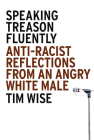
Book Review: Speaking Treason Fluently

I really wanted to like Tim Wise's new book, Speaking Treason Fluently. And at first I did. The articles at the beginning about Obama's campaign were very interesting and relevant to the election at hand (I started reading it sometime at the end of summer). And upon a recent conversation with some acquaintances who spend less time thinking about social injustice, I can see how this book could be very useful. Wise does a good job of incorporating statistical evidence to back up his argument that racism is still a very relevant problem (although he doesn't do the best job of citing his sources). However Wise's newest book is hampered by his denigrating and insulting tone, a lack of intersectional analysis, and the erasure of experiences of non-African-American people of color.

Despite perhaps being more useful to those who have not yet thought deeply about race-relations, this book is clearly not aimed at them. Wise constantly denigrates and insults the intelligence of racist people. I understand that Wise is angry; I'm angry too, and it's easy to just call racists idiots and dismiss them as not worthy of notice. However, ultimately, this is not a constructive way to deal with the problem of racism. Yeah, it's true, they ARE racist, it's totally condemnable. But let's address the difference between ignorance and stupidity. Most racists are not by definition unintelligent as Wise repeatedly implies, but are uninformed and perhaps have not thought deeply about systematic oppression. Perhaps they have been deceived into believing in meritocracy. Perhaps they are themselves struggling with the horror of working hard and not being able to succeed in a society that tells them that anyone who works hard can make it. Perhaps they are unhappy people who have been poorly treated and deceived by their society/government and are clawing to get ahead by tearing down those who are perceived as being socially less worthy than themselves.

I am not excusing their actions and words; it is ignorant and racist. But also I think probably even you, Tim Wise, were once racist yourself, given that we grow up in a culture that practically insures that white people are inculcated with a belief in their own moral superiority. So perhaps instead of insulting people who are racist, giving up on them, and talking to them as if they're idiots with no chance of ever growing, perhaps you should consider that they ARE YOU. You as you were in your past, before you became Oh-So-Enlightened. No, perhaps you never became as extreme and consciously racist as some of these people, but surely you, who have so well explained the structural basis of racism in our society, can understand how they got to that point? Why not try to talk them through a calm, non-insulting, non-alienating transformation of thought instead of giving up on them? After all, we are all harmed by oppression and ideas of superiority (of course not to the same degree, but it is harmful to all of society), so everyone stands to gain from it's destruction. This insulting tone severely wounds the potential of Wise's book. I would have been much more excited to see an analysis that tried to educate instead of denigrate.

I was also alarmed by the lack of intersectionality and power-analysis in Wise's book. There were occasional off-the-cuff remarks and statistics about non-race-based oppression, however there was no incorporation of the way racism interacts with classism, sexism, xenophobia, heterosexism, etc to affect people of color in very different ways. Nor was their much discussion of an intersectional approach that would attempt to reach out to racist people who — though they may not be racial oppressed — might be oppressed in a different way by the same system that harms people of color. For example, it's easy to rag on low-income whites for being racist when they bring down black people. I mean it's TRUE. It IS racist. However the conversation cannot stop there. Classism is all mixed up in racism, and instead of endlessly raging against the moral corruption of low-income whites who don't stand up for black people, how about some interesting conversation about uniting people who are oppressed by the same system, albeit in different ways? Not to excuse low-income whites from personal responsibility, but to try to actually think of a solution, instead of alienating potential allies by condemning them for wanting to get ahead in a system that has taught them they must oppress others in order to be successful. We need some Dorothy Allison up in here. As she says, "The horror of class stratification, racism, and prejudice is that some people begin to believe that the security of their families and communities depends on the oppression of others, that for some to have good lives there must be others whose lives are truncated and brutal." We need to speak to those who have been thus deceived — people who are, in reality, good people (or at least want to be), but who have become used to thinking and acting in a way that oppresses others, whether intentionally or unintentionally.*

Speaking of intersectional oppression, Wise's book concentrated almost exclusively on the way that racism affects African-Americans (not Black people, not people of African descent globally: African Americans only). There were occasional mention of Latinos, and a few spare references to how America treats Arab-Americans post-9/11, but these remarks were usually thrown in as an aside or as additional statistics to back up Wise's arguments about African-Americans. There was no discussion of the way racism affects Asian-Americans in a very different way from the way that it affects Black people. No discussion of the experiences of mixed-race people. Little conversation regarding the treatment of native and indigenous peoples. There would be nothing wrong with that, except that the book made the claim of addressing racism generally; Wise did not say that he was going to focus only on the way that racism affects African-American people, instead he says he hopes that Speaking Treason Fluently (along with his previous book, White Like Me) will "form... an effective one-two punch at the edifice of racism and white supremacy" (Wise 2008: 7). Thus, by claiming to address the effects of racism generally and then by talking almost entirely about the experiences of African-American people, Wise effectively (if perhaps inadvertently) erases the experiences of a wide range of people of color who are NOT African-American. Mixed-race women living abroad, low-income Vietnamese immigrants, Caribbean-American queer people of color, people of Arab descent, native and indigenous populations around the world — the list of people erased by Wise's analysis is long, and the omission of their stories implies that the racism they face is less severe or perhaps even non-existent. I do not think that this is Tim Wise's perspective, but the lack of a broader perspective on racism could imply to a non-alert reader that non-African-American people of color do not face "real" racism.

Wise does an excellent job of incorporating relevant statistics and news events, and his step by step logical breaking down of racist myths had real potential to be useful in the education of those new to the ideas of racial oppression. Reluctant as I am to knock the well-intentioned attempts of allies trying to combat racism, I have to say that Tim Wise could have done a much better job. His extensive collection of anti-racist writings would have benefited from a less-judgemental tone, an intersectional approach to anti-racism work, and a more inclusive selection of evidence that included the experience of many different people of color.


* One of the parts of Wise's book that stuck with me the most acknowledges, in fact that racists are people too and that they have potential to change. While talking about white-denial he says "Acknowledging unfairness then calls decent people forth to correct those injustices. And since most persons are at their core, decent folks, the need to ignore evidence of injustice is powerful: To do otherwise would force whites to either push for change (which they would perceive as against their interests) or live consciously as hypocrites who speak of freedom and opportunity but perpetuate a system of inequality" (Wise 2008: 61). Okay, Wise doesn't seem to be too optimistic about the ability of white racists to overcome white-denial, but he acknowledges that most folks want to be decent people. And it doesn't seem to me that insulting these folks who want to be good people is the best way to get them to cease their racists-ways.
Thursday, December 4, 2008

A Short Disclaimer Before We Begin

So I should say right off the bat that I'm not in school. Neither am I currently active enough to be considered a real activist. However I am deeply interested in social change, feminism, activism, and social justice generally. I've been thinking about going to graduate school for women & gender studies, LGBT studies, social work -- a whole variety of options. If there was a field called "Studies in Ending Oppression and Privilege" I would be in line for that degree. The really big problem for me is that it is really privileged to go to graduate school, and honestly I don't feel like it's necessary in order to have a positive impact on the world. However I sincerely want to learn as much as I can about social injustice, as well as participate in a community that questions the system, challenges me to think more deeply, and encourages me to take direct action. So really I pretty much want to be in school. School for Activists. BUT! I have some ethical problems with attaining a degree that will allow me to get choice jobs over the heads of people who didn't have the money to go to school, but who are probably much more intimately familiar with oppression than I am. Not that we should really quantify oppression, but you get the idea.

Thusly! Follow me as I embark on a quest to read as much social justice literature as I can get my hands on! I shall update you with the new things I've learned, reviews of books I've read, and the status of my quest to effect radical social change. I'm also on the search for practical "how-to" info for wannabe activists, so stick with me and I'll update you on any helpful hints. Not "how to write a press release" hints, although I'm sure those are helpful. More like: how to meet other activists, how to raise hell, how to not starve, how to network with the activists you have a crush on, recommended reading lists, recommended educational programs, activist-y places to locate when you move to a new city, etc.

EDIT:

Also, a few more notes upon poking around a bit more in the feminist/womanist/WOC blogosphere.

1. Yeah, I don't know what I'm doing. Clearly. That's why it's called School For Activists. So — not that anyone's reading this yet — but let's all just stay calm and I'll try really hard NOT to step on anyone's toes, be condescending, erase anyone's experiences, silence anyone with calls for niceness, unwittingly flaunt my privilege, exclude anyone by not talking about them, or generally be an asshat. Because that's some shit. But at the same time I'd like to emphasize again that this is a blog for me to document my progress in trying to become an all-round better informed, more active, and more effective intersectional radical feminist activist. Obviously I'm not there yet.

2. I'm increasingly annoyed whenever I come across statements whose sources are not cited, so (at least in terms of citation, if not style) I'm going to operate as if I were writing an academic paper and cite everything in APA (or by simply linking). Posts will have tags with all the works they cite (author's last name and year, with the exception of statements that are cited through links) and I'm going to keep a running list of works cited under the Reading List if you need more information about specific works.

3. The Blog Roll, Reading List, and Magazine List comprises material that I have either read, read regularly, or really want to read. I'm not going to put anything on there that I haven't looked at least a little bit — enough to know if it's something I want to spend time pursuing or not.